KIA and GAR Against the RATS Architecture: A Checklist
A working reference for RATS-familiar readers evaluating KIA and GAR, and for SOOS implementers who want the RFC 9334 grounding behind each design decision.
Why this document exists
RFC 9334 (the RATS Architecture) is built around a fairly small set of core concepts — Evidence, Attestation Results, Endorsement, Attesting/Target Environment, Reference Value, Layered Attestation, Appraisal Policy, Freshness, and the Passport/Background-Check conveyance models. Anyone evaluating a new attestation profile against that architecture tends to walk through the same list, one term at a time: does this profile have a real answer for Evidence? For Reference Values? For freshness?
This document works through that list explicitly for KIA (draft-sato-soos-kia) and GAR (draft-sato-soos-gar), citing the specific normative text behind each answer rather than describing the intent in the abstract. Where an honest answer is "this isn't fully specified yet," it says so — a checklist that only shows the easy answers isn't a useful one.
1. The role model
KIA declares the Governing Enforcement Component (GEC) — the enforcement kernel at the center of the SOOS governance architecture — as a RATS Attester under RFC 9334, with a complete mapping to every RATS role:
| RATS role | KIA / SOOS equivalent |
|---|---|
| Attester | The GEC instance, via the KIA subsystem |
| Evidence | The GEC Manifest |
| Endorser | The operator root keypair holder |
| Endorsement | The GEC Attestation Certificate |
| Verifier | Inline by the Relying Party (standard deployments); a separate KIA Verification Service (high-assurance deployments) |
| Relying Party | Agents submitting mandates; external audit consumers; federated kernel instances |
| Reference Values | The SOOS KernelSpec conformance version string; expected cedar_policy_set_hashes[] per deployment |
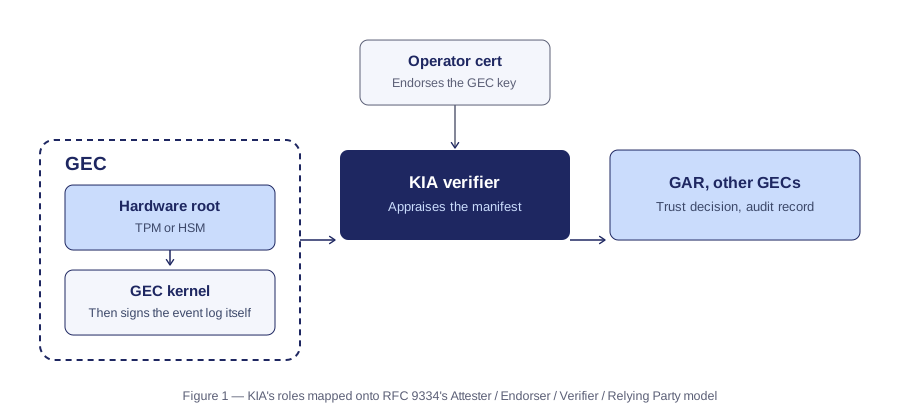
Two things worth flagging up front, since they recur through the rest of this document: a separate Verifier service is optional in the standard deployment model — Relying Parties can verify the GEC Manifest inline against the operator-provisioned public key — and becomes mandatory for exactly one scenario, covered in Section 6.
2. What gives an Attesting Environment its credibility
RFC 9334 describes Attesting Environments as collecting Claims "by reading system registers and variables, calling into subsystems, and taking measurements on code, memory, or other relevant assets of the Target Environment" — an observation model. A second pattern, not named in RFC 9334 itself but implicit in TCG's DICE layering and Root-of-Trust-for-Update thinking, is control: an Attesting Environment that owns the update path into a Target Environment, and is therefore credible because nothing can change without going through it.
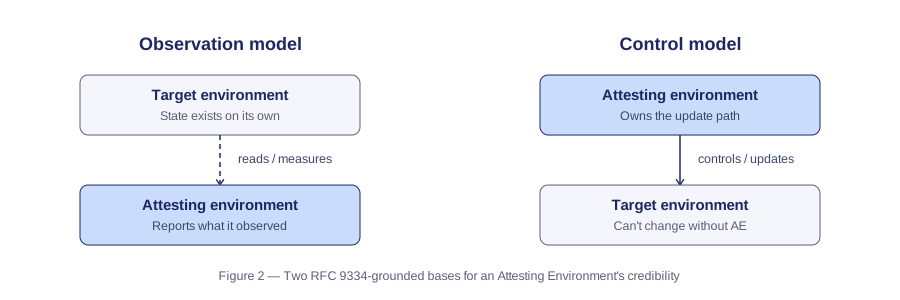
Both patterns share a structural feature: the Attesting Environment and the Target Environment are two distinct things, and the fact being attested exists independently of the act of attesting to it.
GEC fits neither pattern exactly. RFC 9334 explicitly allows "the Attesting and Target Environments [to be] combined into one environment" — the closest existing hook — but even that collapsed case usually still assumes the entity is measuring its own pre-existing state (its own firmware version, say). GEC's Event Log entries are different: the governed decision and its signed record come into existence together, because a kernel.transition() call only happens through the GEC in the first place. There is no separate fact for the GEC to observe or control — the signing act and the occurrence are the same event.
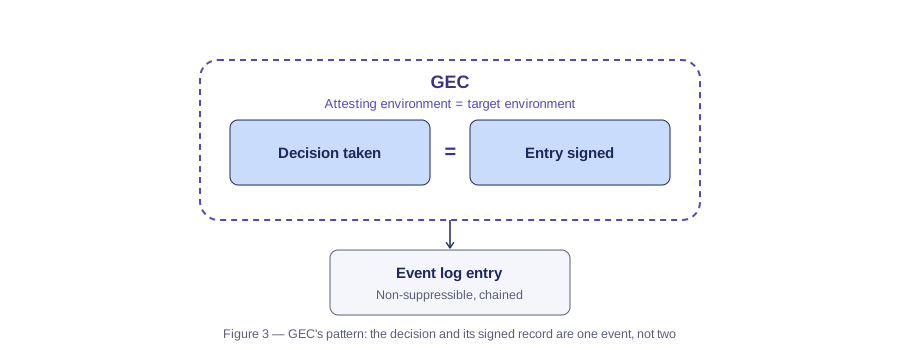
This matters beyond terminology. RFC 9334's own Security Considerations flag the collapsed AE/TE case directly: "Implementers need to evaluate their designs to ensure that the assumed security properties of the individual components and roles still hold despite the lack of separation and that emergent risk is not introduced... Isolation mechanisms in software or hardware that separate Attesting Environments and Target Environments can support an implementer's evaluation." GEC's fusion of its decision engine (CAP, the Constitutional AI Protocol) and its record-keeping function is a specific instance of exactly this named risk. Section 6 covers KIA's compensating control for it.
3. Reference Values
KIA's Reference Values are concrete and narrow: a KernelSpec conformance version string, plus expected cedar_policy_set_hashes[] per deployment. A Verifier is not comparing individual governance decisions against a golden value — it's comparing a hash of the GEC's active policy configuration against the expected one, structurally identical to a firmware-hash comparison, just hashing policy instead of firmware.
Whether any individual decision was the correct application of that policy is decided by CAP inside the Attester, at the moment the decision is signed — not re-derived by the Verifier afterward. This is a deliberate boundary: RATS' own charter excludes appraisal-policy formats from its scope, and KIA doesn't need one, because by the time Evidence exists, policy has already been applied. The Reference Value only confirms it was the right policy set doing the applying.
4. Layered and composite attestation
KIA's trust chain — hardware root, to operator-signed GEC Attestation Certificate, to GEC Manifest, to signed Event Log entries — is a direct instance of RFC 9334's layered attestation model, where an appraised Target Environment becomes the next layer's Attesting Environment. The vocabulary for describing how multiple Attesters compose (Lead Attesting Environment, Component Attesting Environment, and so on) comes from the composite-attesters taxonomy, which has since moved from an Internet-Draft to the RATS wiki — worth citing as a wiki reference rather than a stale I-D.
5. Appraisal policy: two different questions
RFC 9334 distinguishes appraisal policy for Evidence (used by a Verifier to produce an Attestation Result) from appraisal policy for Attestation Results (used by a Relying Party to decide whether to act on one). Section 3 above covers the first half for KIA. The second half — how a Relying Party should weigh a KIA Attestation Result once produced — is not yet specified as its own normative treatment in either draft. Different Relying Parties (an agent's own kernel, an external auditor, a federated peer instance) plausibly have different risk tolerances here, and that gap is open rather than resolved.
6. Freshness, and the honest gap
RFC 9334 treats freshness as a first-class concept (its own glossary entry, alongside "epoch" and "recentness"), typically achieved through a nonce or challenge-response binding that proves Evidence was generated in response to a specific request, not merely generated recently.
KIA-07's current freshness mechanism is narrower: attestation_timestamp is checked against a maximum staleness window (86,400 seconds / 24 hours in the reference implementation, per Section 5.4). This is a plain recency check, not a nonce-bound freshness proof. It does not, on its own, rule out replay of a captured-but-still-within-window GEC Manifest. This is a genuine open item for KIA's normative text, not a documentation gap — worth treating as such in any implementation that has a low tolerance for replay risk within that window.
7. Conveyance: Passport or Background-Check?
RFC 9334 names two canonical conveyance shapes. In the Passport Model, the Attester delivers Evidence directly to a Verifier and carries the resulting Attestation Result itself, presenting it to Relying Parties as needed. In the Background-Check Model, the Attester delivers Evidence to a Relying Party, which forwards it to a separate Verifier and receives the Attestation Result back.
KIA's two deployment modes map onto these, though the drafts don't yet name them explicitly this way: standard deployments, where a Relying Party verifies the GEC Manifest inline, are closest to a collapsed variant where the Relying Party takes on the Verifier role directly. High-assurance deployments, with a separate KIA Verification Service, are closer to genuine Background-Check.
8. The compromise-recovery case (R-8)
This is where KIA's answer to Section 2's "lack of separation" risk actually shows up. GAR's Authority Lifecycle Event (ALE) system tracks a full lifecycle for revoking and restoring an agent's authority. For most revocation classes (R-1 through R-7), recovery is GEC-signed like any other event. For R-8 specifically — compromise — one event in that lifecycle, ALE-007 (ALE_KIA_REATTESTATION_COMPLETED), must be signed by an external KIA Verification Service instead of the GEC itself, because a compromised kernel cannot self-attest its own recovery.
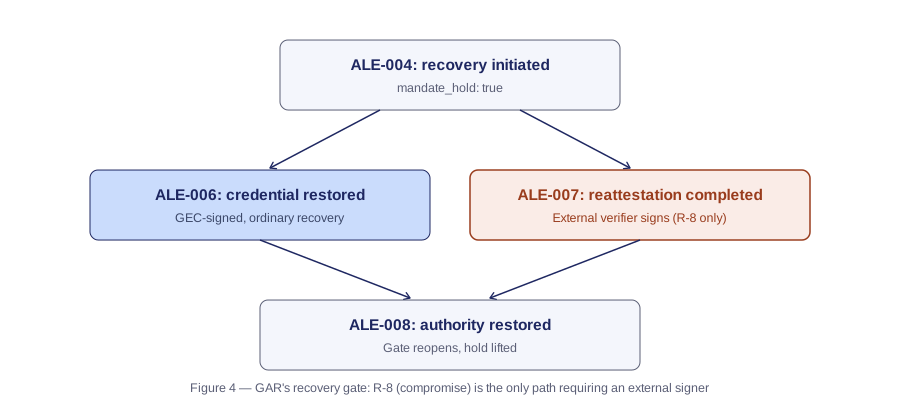
That one record does more than swap the signer. It establishes a genuinely new attestation identity (prior_attestation_id differs from new_attestation_id — continuing to trust the old key isn't sufficient after a compromise), re-checks the Reference Values from outside (new_cedar_policy_hash, new_kernel_version), and records exactly how long the compromise window was (attestation_gap_duration) along with every session that ran during it (sessions_during_gap[]). Those sessions are not automatically invalidated — a named principle ("horizontal non-contamination") prevents one compromised window from retroactively poisoning unrelated concurrent sessions — but they must carry an ATTESTATION_GAP_WARNING and be disclosed in any audit package that touches them.
The gate is structural, not advisory: ALE-004 sets mandate_hold: true the moment recovery starts, blocking all new authorization, and that hold only lifts at ALE-008, which requires either ordinary credential restoration (ALE-006) or this external reattestation (ALE-007) as its prior event. For R-8 specifically, there is no path back to normal operation that skips the external verifier.
One open item here too: neither draft currently specifies exactly how the new attestation identity in new_attestation_id gets minted — whether recovery requires repeating the full original deployment ceremony or something lighter. Given the rest of R-8's design leans toward not trusting anything the compromised instance could have touched, a full ceremony seems the implied intent, but it isn't yet a normative requirement.
Summary checklist
| RFC 9334 concept | KIA / GAR answer | Status |
|---|---|---|
| Evidence | GEC Manifest | Specified |
| Attester | GEC, via KIA | Specified |
| Endorsement | GEC Attestation Certificate | Specified |
| Attesting / Target Environment | Collapsed; constitutive pattern (Section 2) | Specified, not RFC 9334-named |
| Reference Values | KernelSpec version + cedar_policy_set_hashes[] | Specified |
| Layered / composite attestation | Hardware root → cert → Manifest → Event Log | Specified |
| Appraisal policy (Evidence) | Applied by CAP before signing, not re-derived | Specified |
| Appraisal policy (Attestation Result) | Relying-Party-side weighting | Open |
| Freshness / epoch / recentness | Timestamp + staleness window only | Open — no nonce binding yet |
| Passport / Background-Check model | Standard ≈ collapsed; high-assurance ≈ Background-Check | Implicit, not named |
| Compromise recovery (R-8) | External KIA Verification Service; new identity; gap disclosure | Specified |
Status: living document. Sections marked "Open" reflect the current state of draft-sato-soos-kia and draft-sato-soos-gar as of the versions cited above, not a permanent limitation.